

Why Your Body Needs Ultraviolet Light
The hidden signaling network between sunlight, blood, and cellular communication

New here? Start with this guide.
A few years ago I started looking at sunlight differently.
Not as warmth.
Not as vitamin D.
But as information.
Because the deeper you go into biophysics, the stranger the body starts to look.
Cells don’t just communicate with chemicals.
They communicate with electrons, water structure, and light.
And ultraviolet light may be one of the most important signals in that entire system.
I recently wrote a deep research article explaining the mechanisms behind this idea on Unlearn Health. This post is a simpler reflection on the core concept.
Your biology evolved in an environment filled with ultraviolet light.
Modern life quietly removed most of it.
(If you want the full research breakdown, I wrote the long-form article here)
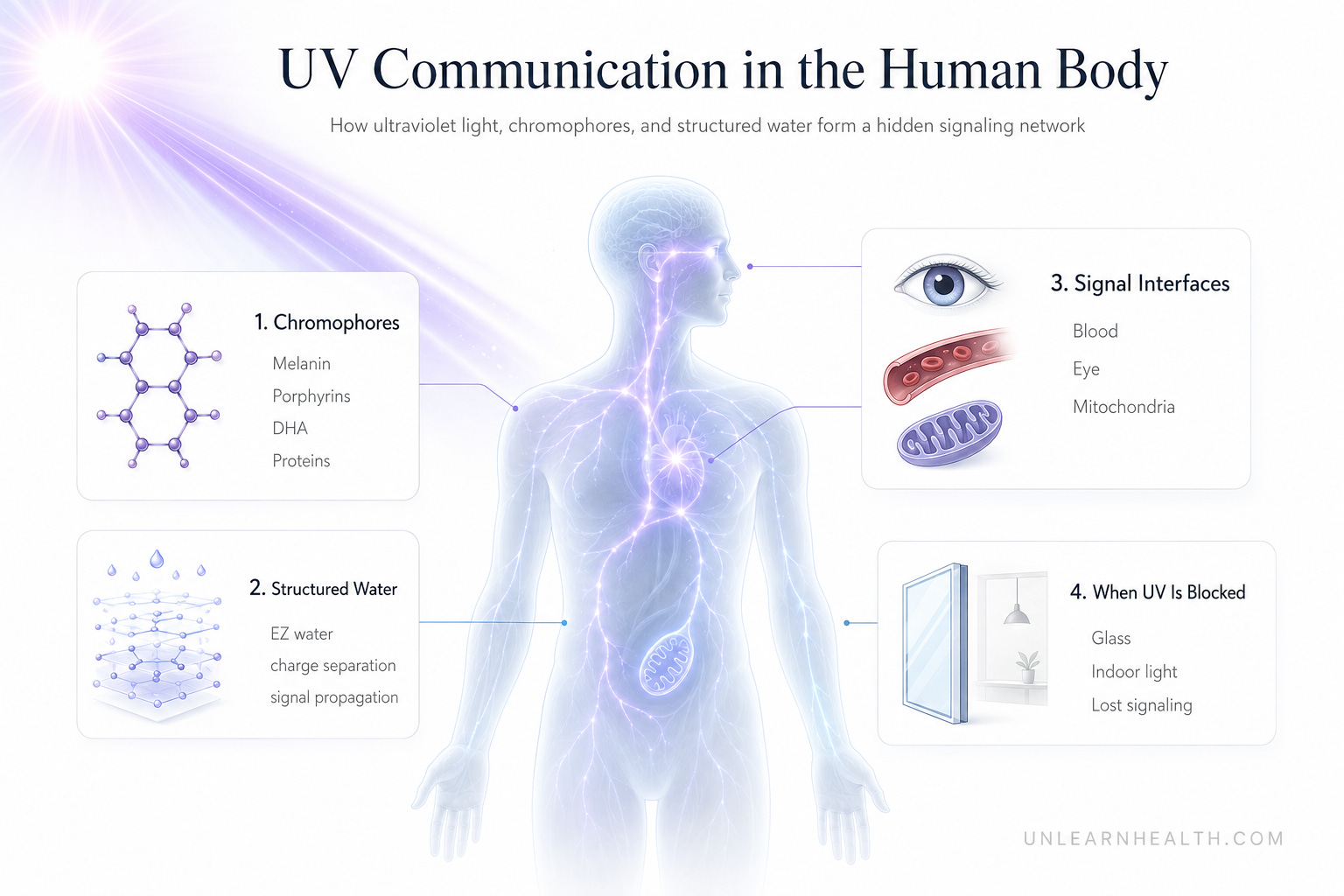
Light Is a Signal, Not Just Energy
Most people think about ultraviolet light in two ways:
• it damages skin
• it makes vitamin D
Both are true.
But they’re incomplete.
Sunlight contains an enormous range of electromagnetic frequencies, and many molecules in the body are built to absorb specific wavelengths.
These molecules are called chromophores.
Some of the most important ones include:
• porphyrins in blood and mitochondria
• melanin in skin and nervous tissue
• DHA in the retina and brain
• aromatic amino acids inside proteins
When these molecules absorb light, they don’t simply heat up.
They translate light into electron movement, electrical signals, and metabolic changes.
Sunlight becomes biological information.
The Body Is Mostly Water — But Not Random Water
There’s another layer to this story that makes things even more interesting.
Inside living organisms, water behaves differently than the water in a glass.
Near proteins and cell membranes, water forms organized layers often called structured water or exclusion zone water.
This water behaves more like a charged gel than a liquid.
It can:
• store electrical charge
• separate electrical potentials
• influence molecular interactions
Experiments have shown that ultraviolet light can expand these structured water zones, increasing electrical potential and energy storage.
So instead of biology being driven only by slow chemical reactions, light may be influencing large organized water networks that help distribute energy across cells.
That possibility opens the door to something biophysicists call coherence.
When systems become coherent, energy moves in coordinated patterns instead of random collisions.
Why Sunlight Dilates Blood Vessels
One of the well-known effects of sunlight exposure is a drop in blood pressure.
Ultraviolet light triggers the release of nitric oxide from stores in the skin.
Nitric oxide relaxes blood vessels and increases circulation near the skin surface.
But this may do more than regulate blood pressure.
Blood is full of porphyrins, molecules that absorb ultraviolet and visible light extremely efficiently.
When circulation increases near the skin during sunlight exposure, the body may be doing something clever:
It’s bringing light-sensitive molecules closer to the incoming signal.
Sunlight is interacting not just with skin cells, but potentially with the blood itself.
Your Eyes Are a Light–Blood Interface
The retina is one of the most unusual tissues in the body.
It contains:
• extremely high concentrations of DHA
• dense mitochondrial populations
• some of the highest blood flow in the body
Large amounts of blood circulate through the retina every hour.
This means light entering the eye interacts not only with neurons but also with vascular and metabolic systems connected to the bloodstream.
Light through the eyes strongly influences:
• circadian rhythm
• hormone release
• brain activity
Your eyes act as a direct interface between environmental light and systemic physiology.
Cells May Actually Communicate With Light
In the early twentieth century, a Russian scientist named Alexander Gurwitsch made a strange observation.
Cells appeared to emit very weak ultraviolet radiation.
He called it mitogenetic radiation because it seemed to influence nearby cell division.
Decades later, physicist Fritz-Albert Popp studied these emissions further.
He found that living organisms emit extremely faint photons called biophotons.
Even more interesting, the emissions appear to be coherent, meaning they are not completely random.
Some researchers believe these photons may reflect coordination between cells.
The idea remains controversial.
But it suggests something remarkable.
Cells might not only use chemicals to communicate.
They may also use light itself.
What Happens When the Signal Disappears
For most of human history, sunlight defined the electromagnetic environment our biology experienced.
Modern life changed that dramatically.
Today many people spend most of their time in environments where:
• ultraviolet light is blocked by glass
• lighting spectra are artificial
• daylight exposure is minimal
The signal our biology evolved with has changed.
Circadian systems, metabolic regulation, and vascular signaling all depend on natural light cycles and spectral balance.
When those signals disappear, biological systems can drift out of alignment.
Environmental Interference
Another layer that rarely gets discussed is how environmental materials interact with light.
Certain metals and crystalline materials reflect or scatter ultraviolet radiation rather than absorbing it.
Examples include:
• aluminum
• heavy metals such as mercury and cadmium
• crystalline silica and quartz
Heavy metals can also bind to proteins and enzymes, altering electron transport and oxidative balance.
That doesn’t mean these materials directly cause disease through light interactions.
But it shows how biological systems rely on extremely precise electronic environments.
Small disruptions can ripple through complex signaling networks.
Health Might Be a Signal Problem
Modern medicine tends to frame disease as chemistry gone wrong.
But there may be another layer.
Living systems depend on coordinated communication.
Cells must remain synchronized with:
• each other
• the environment
• natural light cycles
When those signals stay aligned, biology tends to self-organize.
When they drift apart, regulation becomes harder.
Light is not the only signal that matters.
But it may be one of the most important ones we’ve quietly removed from our lives.
The Big Idea
Your body evolved under sunlight.
Not constant sunlight.
But changing sunlight across the day and across the seasons.
Inside that environment, molecules, water networks, and metabolic systems learned to interpret those signals.
Modern life didn’t remove the sun.
But it changed the signal enough that biology may still be trying to recalibrate.
And if there’s one idea worth keeping in mind, it’s this:
Your body isn’t just reacting to light.
It’s listening for it.
If you’re curious about the deeper environmental biology behind this — particularly how light and cellular energy interact — I explore the full framework in my book The Sunlight Cure.
Follow elsewhere:
YouTube: https://www.youtube.com/@unlearn.health
Instagram: https://instagram.com/unlearnhealth_
TikTok: https://www.tiktok.com/@unlearn.health
X / Twitter: https://x.com/UnlearnHealth_