

Why the Longest-Living Humans Aren’t Athletes
Longevity doesn’t seem to belong to the strongest or fastest bodies

New here? Start with this guide.
For decades we’ve been told that exercise is the foundation of health.
The more you move, the healthier you become. Push harder. Train longer. Build endurance.
But if extreme exercise were the key to longevity, we would expect the longest-living humans to look like elite athletes.
They don’t.
The people who routinely reach extreme ages — centenarians — almost never resemble competitive athletes.
They are not ultra-lean.
They are not highly muscular.
And they almost never spent their lives pushing their bodies through intense training.
Instead, their lives tend to follow a different pattern entirely.
(If you want the full research breakdown, I wrote the long-form article here)
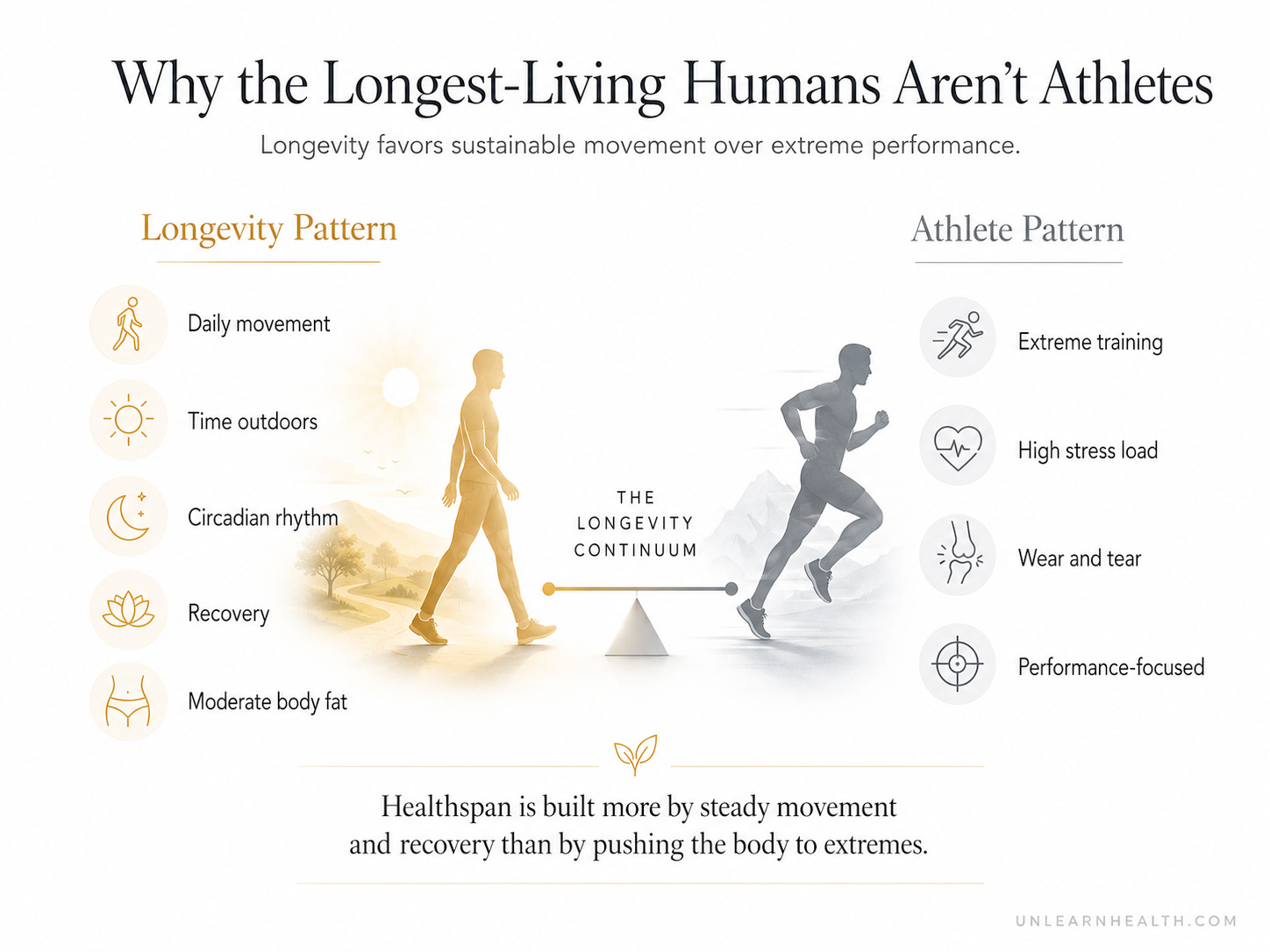
The Centenarian Pattern
Centenarians share a number of lifestyle traits.
They tend to:
move regularly throughout the day
spend significant time outdoors
eat simple diets
maintain strong social connections
experience relatively low chronic stress
But one trait stands out.
They rarely engage in intense athletic training.
Most centenarians simply live physically active lives — walking, gardening, carrying objects, working with their hands.
Their movement is steady and moderate.
It rarely resembles modern endurance training.
Athletes Age Differently
Elite athletes often show a very different pattern.
Their bodies are capable of extraordinary performance during their peak years.
But those same bodies frequently accumulate long-term wear.
High-level endurance athletes experience increased rates of certain cardiovascular conditions, including atrial fibrillation.
Joint degeneration is also common among people who spend decades training intensely.
Many former athletes remain healthy into older age, but the pattern of extreme longevity — living well beyond 100 — rarely appears among elite competitors.
This raises an interesting possibility.
Perhaps the biology that supports peak performance is not the same biology that supports maximum lifespan.
Performance vs Longevity
Athletic training pushes the body toward one goal: performance.
To achieve that goal, the body adapts in several ways:
increasing stress hormone responses
pushing metabolic systems toward high output
increasing oxidative stress during intense effort
prioritizing muscle performance over long-term cellular maintenance
These adaptations can dramatically improve physical capability.
But they may not always align with the biological priorities required for extreme longevity.
Longevity seems to favor stability.
Performance favors intensity.
The Role of Recovery
Another important factor is recovery.
Intense training repeatedly pushes the body into states of physical stress and tissue damage.
In younger individuals, repair systems generally keep up.
But over many decades, the cumulative burden of repair can become significant.
This doesn’t mean movement is harmful.
Movement is essential.
The question is how much stress the body is designed to absorb repeatedly over a lifetime.
Moderate daily movement appears to stimulate repair and metabolic health without overwhelming the body’s recovery systems.
Extreme training may shift that balance.
Look at Other Primates
If we look at our closest evolutionary relatives, the pattern becomes even more interesting.
Wild primates do not engage in extended endurance exercise.
They move regularly throughout the day.
But their movement tends to occur in short bursts — climbing, walking, foraging, and occasional brief sprints.
Long periods of continuous intense exertion are rare.
Their activity patterns resemble moderate daily movement far more than modern athletic training.
Movement vs Overtraining
This distinction matters.
The comparison isn’t between exercise and inactivity.
The comparison is between moderate movement and extreme training.
Moderate movement appears to support:
metabolic flexibility
mitochondrial health
stable hormone signaling
long-term tissue integrity
But pushing the body toward maximum output repeatedly may introduce different trade-offs.
Especially over many decades.
The Environment Matters Too
Another piece of the longevity puzzle is the environment the body operates in.
The longest-living populations often spend large amounts of time outdoors.
Natural light exposure helps regulate circadian rhythms.
Circadian rhythms influence mitochondrial function, hormone regulation, and cellular repair systems.
These processes affect how efficiently the body produces energy and maintains tissue integrity.
When environmental signals like light and circadian timing remain stable, biological systems tend to operate more efficiently.
Over a lifetime, that stability may matter more than peak physical performance.
Longevity Favors Balance
None of this suggests that exercise is harmful.
Movement is fundamental to human health.
But the type of movement that supports extreme longevity may not resemble the modern image of athletic fitness.
The longest-living humans rarely push their bodies to extremes.
Instead they tend to move steadily throughout life.
They walk.
They work.
They remain physically engaged with their environment.
But they rarely train like athletes.
Longevity, it seems, favors balance rather than intensity.
If you’re curious about the deeper environmental biology behind this — particularly how light and cellular energy interact — I explore the full framework in my book The Sunlight Cure.
Follow elsewhere:
YouTube: https://www.youtube.com/@unlearn.health
Instagram: https://instagram.com/unlearnhealth_
TikTok: https://www.tiktok.com/@unlearn.health
X / Twitter: https://x.com/UnlearnHealth_