

Why Cancer May Be Nothing to Fear
What cancer might actually reveal about cellular energy and biological signaling.

New here? Start with this guide.
Cancer is one of the most feared words in the world.
But what if the fear comes from misunderstanding what cancer actually is?
Most people imagine cancer as something that suddenly attacks the body — rogue cells multiplying out of control for no reason.
But when you zoom out and look at cellular metabolism, a different picture starts to emerge.
One that is far less mysterious.
And far less frightening.
(If you want the full research breakdown, I wrote the long-form article here)
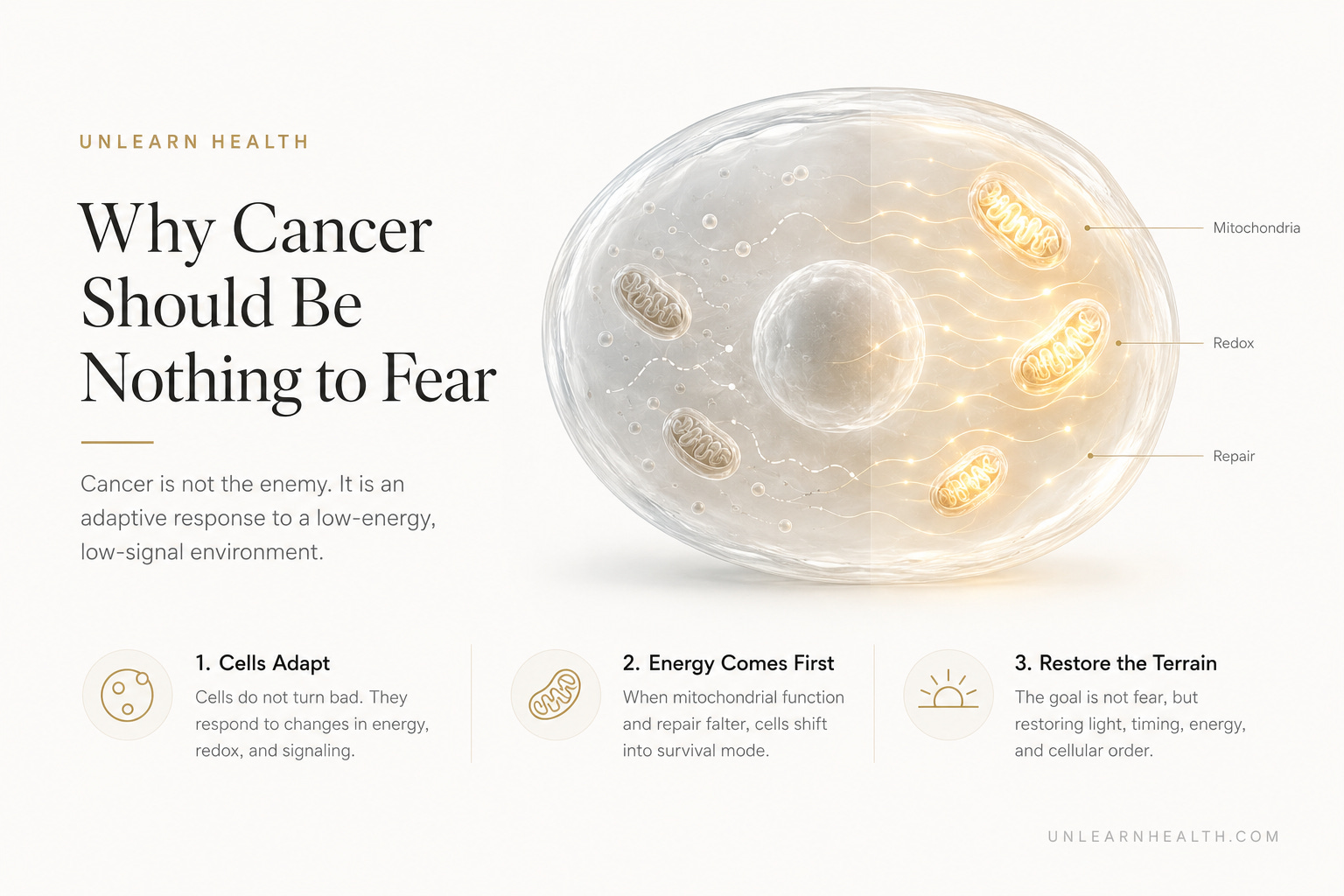
Cells Don’t Randomly Rebel
Cells are not chaotic.
They are extremely responsive to their environment.
Every second, your cells are evaluating signals like:
energy availability
oxygen levels
redox balance
damage signals
nutrient flow
Based on those signals, a cell decides whether to:
repair itself
divide
pause growth
or self-destruct
This decision system normally works remarkably well.
But like any system, it depends on clear signals and reliable energy.
When those degrade, the decisions begin to change.
The Warburg Clue
Nearly 100 years ago, Otto Warburg noticed something strange.
Cancer cells stop relying on normal mitochondrial respiration and instead shift toward fermentation.
At first this looked like a defect.
But it may actually be a survival strategy.
Fermentation is inefficient, but it allows a cell to keep generating energy when mitochondria are struggling.
It’s a metabolic fallback mode.
From that perspective, cancer starts to look less like a random malfunction and more like an adaptation to poor energy conditions.
When Cellular Signals Become Noisy
Healthy metabolism depends on clean electron flow through the mitochondria.
This electron movement produces tiny reactive signals that help coordinate cellular behavior.
Those signals regulate things like:
DNA repair
growth timing
apoptosis (programmed cell death)
immune detection
But when mitochondrial function deteriorates, those signals become distorted.
Cells begin receiving incomplete or inaccurate feedback about their own state.
Repair systems slow.
Apoptosis stops activating when it should.
And gradually, order begins to break down.
Cancer Often Appears When the System Loses Its Coordination
The body actually has multiple safeguards to prevent this.
Two of the most important are:
Autophagy — recycling damaged cellular components.
Apoptosis — removing cells that can’t be repaired.
These systems work extremely well when energy signaling is intact.
But when cellular energy becomes unstable, those safeguards can fail.
The result is not immediate chaos.
It’s slow disorganization.
Cancer is often what that disorganization looks like at the cellular level.
The Fear Narrative
Modern medicine often frames cancer as a war.
Something foreign that must be attacked.
But the cells involved are still your own cells.
Which means the deeper question isn’t just:
“How do we destroy them?”
It’s also:
“What conditions led cells to behave this way in the first place?”
That shift in perspective changes the emotional response dramatically.
Instead of fear, you start asking better questions about the environment cells are responding to.
The Part Most People Miss
Biology is not just chemistry.
Cells are constantly responding to environmental signals.
Things like:
light exposure
electromagnetic environments
circadian timing
temperature signals
metabolic inputs
These signals shape mitochondrial function and cellular energy.
When they drift far from the conditions humans evolved in, cellular coordination becomes harder to maintain.
Over time, that instability can show up in many different ways.
Cancer is one of them.
Understanding Removes Fear
Fear comes from believing the body is fragile and unpredictable.
But biology is usually responding to signals.
And signals can change.
Once you understand that, cancer stops looking like a mysterious enemy.
It starts looking like a biological warning system that something deeper has gone wrong.
That shift alone removes a surprising amount of fear.
If you’re curious about the deeper environmental biology behind this — particularly how light and cellular energy interact — I explore the full framework in my book The Sunlight Cure.
Follow elsewhere:
YouTube: https://www.youtube.com/@unlearn.health
Instagram: https://instagram.com/unlearnhealth_
TikTok: https://www.tiktok.com/@unlearn.health
X / Twitter: https://x.com/UnlearnHealth_