

The Health Principle Almost Everyone Misses: Biology Is Non-Linear
Why the most powerful influences on your biology may be the signals you barely notice

New here? Start with this guide.
Most people think the body works like a machine.
Put something in.
Get something out.
Eat fewer calories = lose weight.
Take a supplement = fix a deficiency.
Avoid a toxin = prevent disease.
This model feels intuitive.
But living systems rarely behave this way.
Biology is non-linear.
And once you understand that, many confusing health problems suddenly make more sense.
(If you want the full research breakdown, I wrote the long-form article here)
But the key idea is simple.
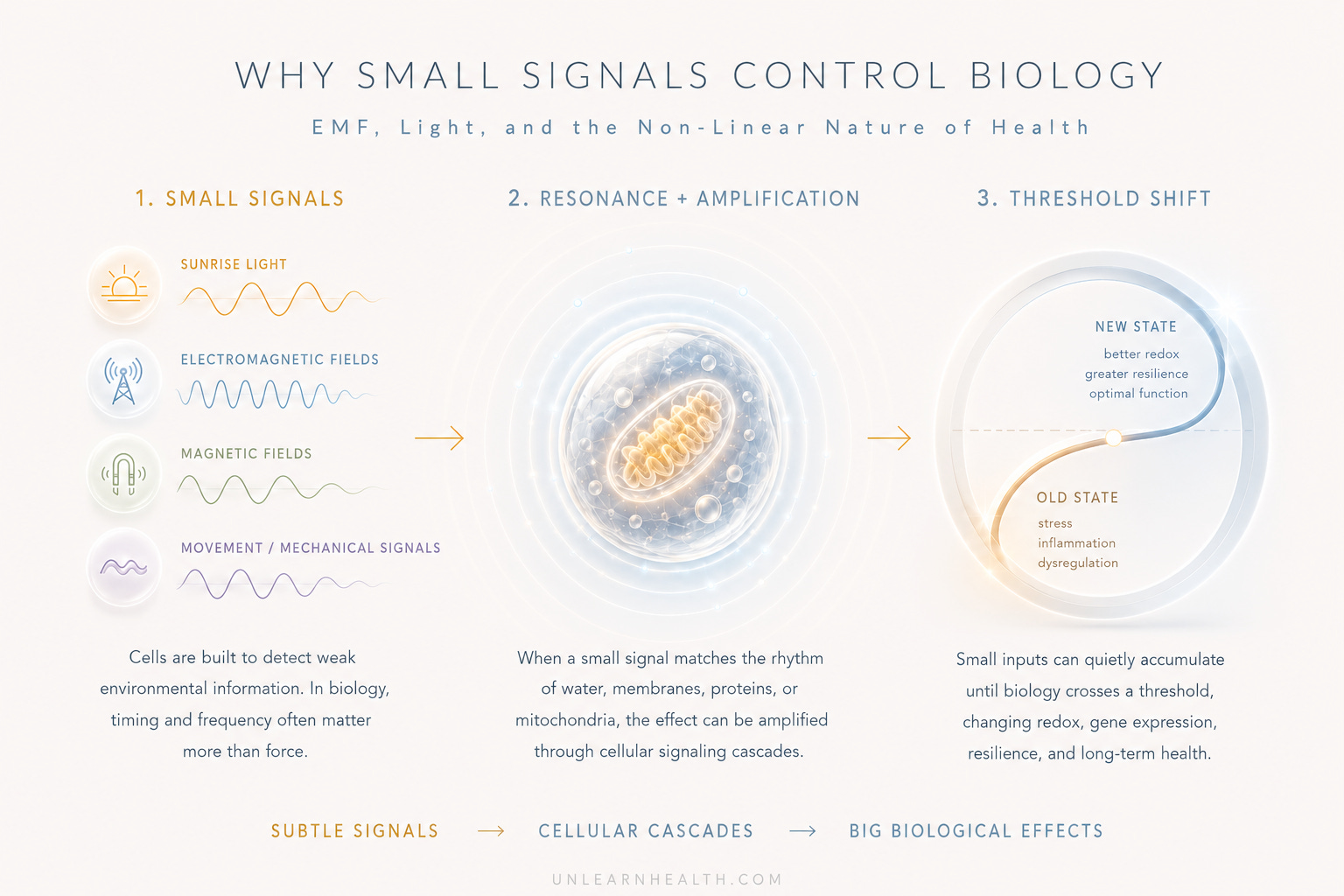
Small signals can sometimes produce very large biological effects.
And sometimes the signals that matter most are the ones we barely notice.
The Swing Analogy
Think about pushing a child on a swing.
You don’t need a strong push.
A tiny push works — if it arrives at the right moment.
Push at the wrong time and nothing happens.
Push at the right rhythm and the swing goes higher and higher.
The force wasn’t large.
But the timing matched the system.
This phenomenon is called resonance.
And biology is full of systems like this.
Cells, proteins, water networks, and electrical signaling all operate with natural rhythms.
When environmental signals align with those rhythms, the biological response can become amplified.
The Small Signal Problem
Modern health thinking focuses almost entirely on big inputs.
Large toxin exposures.
Severe nutrient deficiencies.
Extreme stress.
But living organisms evolved in environments filled with subtle signals.
Changes in light during sunrise.
Seasonal temperature shifts.
Daily movement patterns.
Magnetic fields of the Earth.
Tiny signals.
Yet organisms evolved systems designed to detect and amplify them.
That means the body is often far more sensitive to environmental information than we assume.
The Stage Your Biology Performs On
One helpful way to understand this is through a theater analogy.
Your DNA is the script.
But the performance depends on the stage.
Lighting. Temperature. Atmosphere. Acoustics.
Change the stage environment and the same script produces a completely different performance.
Biology works the same way.
Environmental signals shape the conditions under which cells operate.
Light exposure, temperature, movement, electromagnetic signals, magnetic fields, these factors change the stage your biology performs on.
The genes remain the same.
But the behavior of the system shifts.
Why Small Changes Sometimes Create Big Results
If biology behaved like a simple machine, health would be easy to understand. Small inputs would create small, predictable outputs.
But living systems don’t work that way.
Non-linear systems can appear stable for long periods before shifting suddenly. The change often looks abrupt, even though the underlying process has been unfolding quietly for a long time.
A simple analogy is leaning back in a chair.
At first nothing happens. You can tilt farther and farther and the chair still feels stable. Then, almost instantly, it tips.
The tipping moment wasn’t when the process started. It was simply the point where the system could no longer maintain balance.
Biological systems behave in much the same way. Small influences accumulate quietly until the system eventually crosses a threshold and moves into a different state.
The Delay Problem
Another reason this principle is difficult to recognize is time delay.
Many biological systems integrate signals slowly rather than responding immediately. The effects build gradually, often unfolding over months or years before anything noticeable appears.
Tooth decay is a good example. Eating sugar once does not create a cavity, but repeated exposure slowly shifts the environment of the mouth until enamel begins to break down. By the time a cavity appears, the process has usually been developing for a long time.
Weight gain works similarly. No one notices gaining two pounds over a few months, yet over several years those small increases accumulate into a major shift in metabolism and body composition.
When cause and effect are separated by long delays, the connection becomes much harder to recognize.
Invisible Forces Still Shape Biology
Another complication is that many environmental signals are not consciously detectable.
Gravity shapes bone density throughout life.
But you never feel gravity altering your skeleton.
Altitude slowly changes blood oxygen capacity.
But the adjustment unfolds over hours or days.
Cells operate at microscopic scales.
Electrical gradients, electron flow, and molecular vibrations shape biology in ways our senses cannot detect.
Just because something isn’t felt doesn’t mean it isn’t influencing the system.
Why This Changes How You Think About Health
Once you see biology as a non-linear system, many health mysteries become easier to understand.
Why small lifestyle changes sometimes produce dramatic improvements.
Why people can feel fine for years before symptoms appear.
Why subtle environmental shifts can reshape physiology.
Health isn’t just chemistry.
It’s physics.
It’s signals interacting with living systems that evolved to detect them.
And in non-linear systems, small signals can matter far more than expected.
A Question Worth Asking
If biology amplifies subtle signals…
Then the most powerful influences on health might not always be the obvious ones.
Sometimes the signals shaping the system are the ones we barely notice.
And sometimes the biggest changes in biology begin with the smallest signals.
If you’re curious about the deeper environmental biology behind this — particularly how light and cellular energy interact — I explore the full framework in my book The Sunlight Cure.
Follow elsewhere:
YouTube: https://www.youtube.com/@unlearn.health
Instagram: https://instagram.com/unlearnhealth_
TikTok: https://www.tiktok.com/@unlearn.health
X / Twitter: https://x.com/UnlearnHealth_