

The EMF Question Most People Are Not Asking
Most arguments about EMF get stuck in the same boring place.

One side says, “It is non-ionizing, so it cannot hurt you.”
The other side says, “I feel terrible around Wi-Fi, cell towers, phones, laptops, and electric cars.”
Then everyone argues about whether artificial electromagnetic fields are strong enough to heat tissue or break DNA directly.
But I think that is the wrong question.
The better question is this:
Can artificial fields interfere with the electrical systems the body already uses to regulate itself?
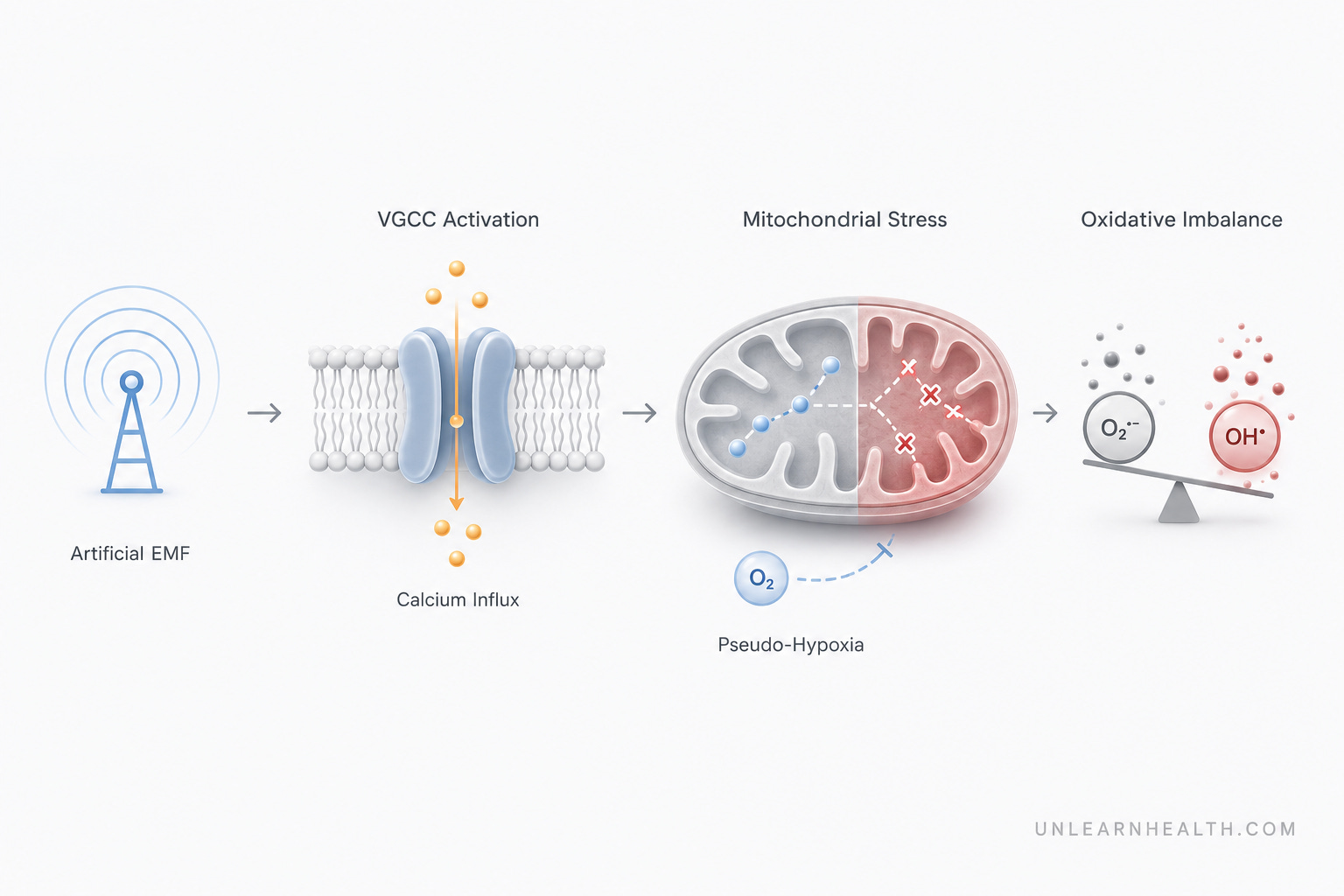
Because the body is not just chemistry. The body is electrical, electromagnetic, mineral-based, water-based, light-sensitive, voltage-sensitive biology. Every cell holds a charge across its membrane. The brain runs on electrical signaling. The heart depends on rhythm. Muscles contract through ion movement. Mitochondria make energy by moving electrons. Calcium acts like one of the body’s most powerful command signals.
So the real issue may not be whether EMF “cooks” you.
The issue may be whether artificial fields create noise in a system that depends on electrical order.
I wrote the deeper technical version here:
This Substack version is the simplified frame.
Your Body Is Already Electrical
Most people think of electricity as something outside the body.
Power lines. Routers. Bluetooth devices. Phones. Cars. Laptops. Cell towers.
But your body is not separate from electricity. Your body is built from electrical gradients.
Your nerves communicate through voltage changes. Your heartbeat depends on coordinated electrical timing. Your muscles move because electrical signals trigger calcium release. Your mitochondria use membrane potential to produce ATP. Even your skin, fascia, blood, collagen, and water structure are part of a living electrical system.
This is why the standard safety conversation feels incomplete.
When someone says, “Non-ionizing radiation does not have enough energy to break chemical bonds,” that may be true in the narrow sense. But biology is not only damaged by brute force. Biology can also be disrupted at the control-system level.
A signal does not need to smash a molecule to change what a cell does.
It only has to interfere with the systems that decide how the cell behaves.
Calcium Is Not Just a Mineral
Most people think of calcium as a bone mineral.
But inside the cell, calcium is more like a command signal.
When calcium moves properly, it helps coordinate nerves, muscles, hormones, blood vessels, immune cells, enzymes, and mitochondria. It tells the body when to contract, release, fire, repair, defend, or respond.
That makes calcium powerful.
It also makes calcium dangerous when the timing is wrong.
One of the major theories of EMF damage comes from Martin Pall’s work on voltage-gated calcium channels. The basic idea is that artificial electromagnetic fields may disturb these voltage-sensitive gates in the cell membrane, allowing too much calcium to enter the cell at the wrong time.
This does not require EMF to directly break DNA. It does not require obvious tissue heating. It is a different model entirely.
The field affects a sensitive gate.
The gate changes calcium movement.
Calcium changes the cell.
That is a much more interesting biological question than whether a router can cook tissue.
Why a Small Signal Can Create a Big Effect
People often dismiss EMF concerns by saying the fields are “too weak.”
But that assumes the body only responds to raw energy intensity.
Living systems do not work that way. Biology contains amplifiers. A small signal at the wrong control point can create a much larger downstream effect.
Think about hormones. A tiny amount of a hormone can change mood, metabolism, fertility, hunger, sleep, immune function, and growth. The body responds not because the hormone is “high energy,” but because the system is designed to listen to it.
Calcium channels are similar. They are not random structures sitting in the membrane. They are voltage-sensitive regulatory gates. When they open, calcium enters. When calcium enters, the cell changes behavior.
This is why the EMF conversation should not only be about intensity.
It should also be about sensitivity, timing, biology, and context.
A weak signal can matter if it is interpreted by a sensitive system.
The Mitochondria Problem
Once calcium rises inside the cell, mitochondria become one of the main systems affected.
Mitochondria are often described as the “powerhouses” of the cell, but that phrase is too simple. They are more like electrical-redox engines. They move electrons through a chain of proteins and membranes until oxygen accepts those electrons at the end.
That controlled electron flow is what allows the body to turn food, oxygen, minerals, light, and water into usable energy.
When calcium signaling is normal, mitochondria can use calcium as part of energy regulation. But when calcium pressure becomes excessive or chronic, mitochondria are forced to buffer a signal they were not designed to carry all day.
This can destabilize mitochondrial membrane potential, increase electron leak, weaken ATP production, and shift the cell toward oxidative stress.
That is where EMF theory becomes much bigger than “radiation exposure.”
It becomes a question of mitochondrial order.
Can the cell maintain clean electron flow under artificial electrical noise?
Pseudo-Hypoxia: Oxygen Is There, But the Cell Cannot Use It Properly
This may be the most important part.
Hypoxia usually means low oxygen.
Pseudo-hypoxia is different. It means oxygen may be present, but the cell behaves as if oxygen is not being used properly.
This matters because oxygen is not useful just because it is in the blood. Oxygen becomes useful when mitochondria can reduce it cleanly at the end of the electron transport chain.
In plain English: oxygen has to receive electrons properly.
If electron flow is disrupted, oxygen can be present while the cell still struggles to produce energy cleanly.
That is one reason a pulse oximeter can look normal while someone still feels exhausted, wired, foggy, inflamed, or metabolically stressed. Blood oxygen saturation does not prove that mitochondria are using oxygen well.
This is the deeper biophysical concern with EMF.
The problem is not necessarily “radiation damage” in the cartoon sense. The problem may be electrical disorder pushing the cell toward poor oxygen use, poor electron flow, and poor redox control.
Why Symptoms Can Feel So Random
This model also helps explain why EMF-related symptoms, when they occur, can look so broad and inconsistent.
If the mechanism touches calcium signaling, mitochondrial function, nitric oxide chemistry, nervous system excitability, sleep timing, and redox balance, the symptoms would not be expected to follow one neat pattern.
One person may feel brain fog.
Another may feel wired at night.
Another may notice heart palpitations, irritability, head pressure, eye strain, poor recovery, skin sensitivity, anxiety, fatigue, or a general sense that their body cannot fully downshift.
None of those symptoms prove EMF is the cause in every case. But they do fit the larger idea of a voltage-sensitive, mitochondria-sensitive, terrain-dependent stressor.
The same exposure may not affect everyone the same way because the receiver is different.
A well-slept, sun-adapted, mineral-replete, grounded, high-redox body may tolerate a modern signal environment better than a sleep-deprived, indoor-bound, under-sunned, blue-light-saturated body with poor mitochondrial reserve.
The signal matters.
But so does the state of the body receiving it.
Nighttime Exposure Matters More Than People Think
The body is not supposed to receive the same signal environment at midnight that it receives at noon.
At night, biology expects darkness, coolness, lower stimulation, melatonin signaling, reduced sympathetic tone, and repair. This is when the brain cleans itself, mitochondria recover, hormones reset, immune systems recalibrate, and tissues rebuild.
That is why the bedroom matters so much.
A router beside the bed, a phone charging near the head, Bluetooth devices, bright screens, dirty electricity, and artificial light at night are not just “small exposures.” They are signals arriving during the repair window.
The issue is not only field strength.
The issue is timing.
A stressor the body might handle better during the active phase can become more disruptive during the repair phase. This is why I think the sleep environment should be the cleanest electrical environment of the day.
Not because technology is evil.
Because repair requires a different signal environment than stimulation.
The Bigger Mismatch
The deeper problem is not one phone, one router, or one tower.
The deeper problem is that modern humans live inside an artificial signal stack.
We spend most of the day indoors under artificial light. We work on screens. We sleep near electronics. We drive metal vehicles full of sensors and wireless systems. We wear Bluetooth devices. We live in buildings surrounded by wiring, routers, smart meters, towers, and dirty electricity.
At the same time, we receive less sunlight, less darkness, less grounding, less outdoor air, less temperature variation, less mineral-rich food, less seafood, less movement, and less direct contact with the natural environment.
That is the real mismatch.
Artificial fields become more biologically relevant because they arrive in the absence of the natural signals that should regulate the body.
The body gets more noise and less order.
This Is Not About Fear
I do not think the answer is to panic about every device.
Fear is not a health strategy.
The better frame is signal hierarchy.
Technology should not dominate the body’s signal environment while sunlight, darkness, grounding, movement, real food, mineral-rich water, and clean sleep are treated as optional lifestyle accessories.
That is backwards.
The body was built inside nature first. Modern technology came later. The goal is not to reject modern life completely. The goal is to stop pretending biology can thrive when artificial signals replace natural ones.
This is also why I do not like the supplement-centered response to EMF.
If the issue is upstream signal disruption, calcium stress, mitochondrial electron leak, poor oxygen reduction, and redox instability, then “take more antioxidants” is a weak frame. The body does not need a permanent consumer stack to survive a bad environment.
It needs a better environment.
The Simple Takeaway
The strongest EMF concern is not that artificial fields directly burn tissue or instantly break DNA.
The stronger concern is that artificial fields may interfere with voltage-sensitive biology.
That means calcium signaling, mitochondrial electron flow, oxygen use, nitric oxide chemistry, sleep repair, nervous system regulation, and redox balance.
This is why EMF should not be discussed only as “radiation.”
It should be discussed as an artificial signal entering an electrical body.
And once you see it that way, the solution becomes less paranoid and more obvious.
Reduce the unnecessary artificial signal.
Restore the natural signal.
Make the bedroom cleaner.
Get sunlight in your eyes and on your skin.
Make the night dark.
Spend more time outside.
Eat food that builds membranes, minerals, mitochondria, and redox capacity.
Keep technology useful, but do not let it become the environment your biology has to adapt to all day and all night.
The goal is not to fear modern fields.
The goal is to rebuild the signal environment the body was designed to understand.
If you’re curious about the deeper environmental biology behind this — particularly how light and cellular energy interact — I explore the full framework in my book The Sunlight Cure.
Follow elsewhere:
YouTube: https://www.youtube.com/@unlearn.health
Instagram: https://instagram.com/unlearnhealth_
TikTok: https://www.tiktok.com/@unlearn.health
X / Twitter: https://x.com/UnlearnHealth_