

Artificial Light Is Rewiring Your Brain
And Almost Nobody Notices

New here? Start with this guide.
Most people think of light as something that helps us see.
Turn on a lamp.
Open a laptop.
Check your phone.
Light is treated as a visual tool.
But biologically, light is something very different.
It is one of the most powerful environmental signals the human body receives. Light doesn’t just enter the eye and create vision. It enters the eye and begins altering chemistry—changing how mitochondria work, how dopamine behaves, how circadian rhythms operate, and how the brain regulates mood, focus, and sleep.
Modern life has quietly changed that signal.
Not by removing light.
But by changing its spectrum.
(If you want the full research breakdown, I wrote the long-form article here)
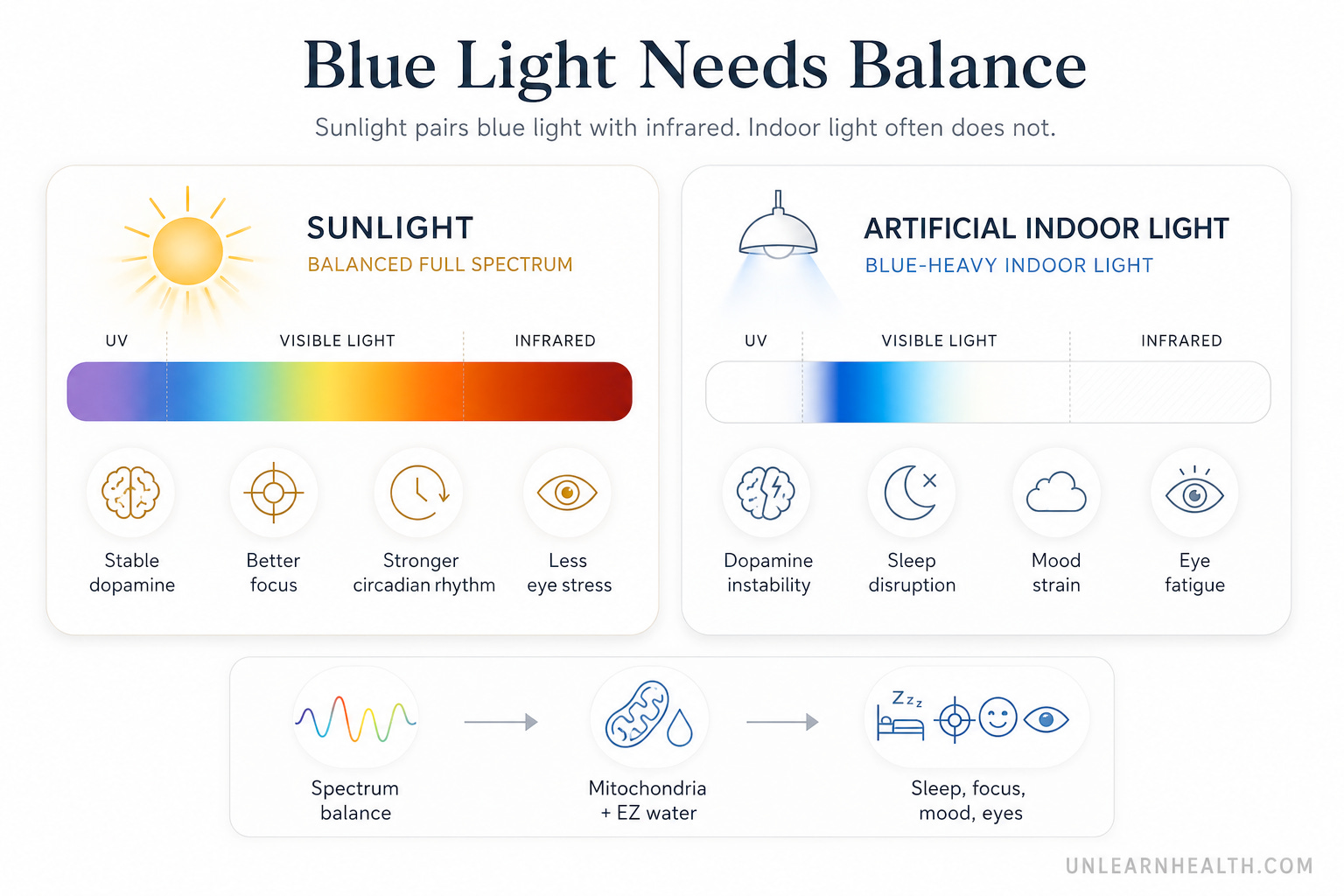
The Spectral Problem of Modern Life
Sunlight contains a broad distribution of wavelengths.
Ultraviolet.
Visible light.
Infrared.
All arriving together.
Artificial lighting is very different.
Most modern indoor lighting—LEDs, screens, and fluorescent lights—produce a heavy concentration of blue wavelengths while lacking much of the infrared energy found in sunlight.
This creates a strange biological environment.
A world where blue light appears constantly but the wavelengths that normally balance it are largely absent.
To your eyes, this may seem irrelevant.
To your cells, it may not be.
Why Infrared Matters More Than Most People Realize
Infrared light plays a subtle but important role in biological systems.
One of the places it appears to matter most is in water.
Inside cells, water is not simply a passive liquid. Near biological surfaces, water organizes into structured layers sometimes called exclusion zone water.
These structured layers influence electrical charge separation and cellular energy systems.
Infrared radiation has been shown to expand and stabilize this structured water.
Why does that matter?
Because mitochondria—the energy systems inside cells—depend on stable electrical gradients and organized water layers to move electrons efficiently.
When those gradients destabilize, electron flow becomes less efficient.
And when electrons leak from the system prematurely, oxidative stress rises.
Dopamine Runs on Redox Chemistry
Dopamine is usually discussed as a psychological molecule.
Motivation.
Reward.
Attention.
But dopamine is also a redox-sensitive molecule, meaning its behavior depends heavily on the oxidative environment of the cell.
When oxidative stress rises, dopamine becomes easier to degrade.
That matters because dopamine stability influences many of the experiences people associate with mental health and cognitive performance.
Mood regulation.
Motivation.
Emotional resilience.
Focus.
If the cellular environment shifts toward oxidative imbalance, dopamine signaling may become less stable.
And that instability can ripple through many areas of daily life.
Mood, Irritability, and Anxiety
Many people notice a subtle psychological pattern during long periods indoors.
Mood becomes flatter.
Patience shortens.
Irritability increases.
Small frustrations trigger larger reactions.
These experiences are often attributed to stress or lifestyle factors, but environmental signals may also play a role.
Light affects circadian timing, mitochondrial metabolism, and neurotransmitter systems simultaneously.
When the light environment changes, the brain’s chemical landscape changes with it.
Focus and the ADHD Environment
Attention depends heavily on dopamine signaling within the prefrontal cortex.
When dopamine signaling is stable, neural circuits filter information efficiently.
When dopamine signaling becomes erratic, attention can fragment.
Modern environments present a strange combination of factors:
Constant digital stimulation.
Artificial lighting.
Minimal natural light exposure.
Interestingly, multiple studies have observed that time spent outdoors correlates with reduced ADHD symptoms in children.
The explanation is likely multifactorial—but environmental light may be one of the most overlooked variables.
Sleep Begins in the Morning
Sleep is often treated as a nighttime problem.
But circadian biology suggests something different.
The signals that determine when you fall asleep tonight begin many hours earlier—especially through light exposure.
Sunlight during the day strengthens circadian amplitude.
Artificial lighting late at night delays circadian timing.
When days are spent almost entirely indoors, circadian signals become weaker and less stable.
This can produce a familiar pattern:
Difficulty falling asleep.
Fragmented sleep.
Morning grogginess.
Why Your Eyes Get Tired
The human visual system evolved under sunlight.
Not under narrow-spectrum LEDs.
Screens concentrate high-energy blue wavelengths into a small visual field, often for hours at a time.
Without the broader spectral environment of sunlight—including large amounts of infrared energy—ocular tissues may experience greater metabolic stress.
Many people recognize the symptoms:
Dry eyes.
Headaches.
Visual fatigue.
The issue may not simply be screen time.
It may be the spectral imbalance of the environment those screens exist within.
The Modern Light Environment
For most of human history, blue light rarely appeared without infrared light.
Sunlight delivered both together.
Today the situation is reversed.
Blue light appears constantly—from screens, overhead lighting, and digital devices—while infrared exposure is drastically reduced indoors.
From a biological perspective, this creates a new environment the brain did not evolve to interpret.
And the consequences may reach further than most people realize.
A Simple Question
What would happen if the environment surrounding modern behaviors changed?
If the same actions—checking a phone, reading messages, scrolling through information—happened under sunlight instead of artificial light?
Would dopamine behave differently?
Would attention stabilize?
Would mood shift?
That’s a question worth testing.
Not through theory alone.
But through experiment.
A Small Experiment
I recently started running a simple experiment.
For one week, I only check my phone outside.
Messages, email, scrolling—anything that triggers dopamine—happens under natural light.
No complicated protocol.
Just a simple rule.
If I want to use my phone, I step outside first.
It’s a small change.
But sometimes small environmental shifts reveal much bigger biological patterns.
I’ll share what I notice in future posts.
If you’re curious about the deeper environmental biology behind this — particularly how light and cellular energy interact — I explore the full framework in my book The Sunlight Cure.
Follow elsewhere:
YouTube: https://www.youtube.com/@unlearn.health
Instagram: https://instagram.com/unlearnhealth_
TikTok: https://www.tiktok.com/@unlearn.health
X / Twitter: https://x.com/UnlearnHealth_